
A Social Implementation Project Creating a Positive Cycle of Food, Energy, and Resources Starting with Agriculture Basic Agreement Signed for “AGRI-4X”
February 26, 2026 PRESS RELEASE
A Social Implementation Project Creating a Positive Cycle of Food, Energy, and Resources Starting with Agriculture
Basic Agreement Signed for “AGRI-4X”
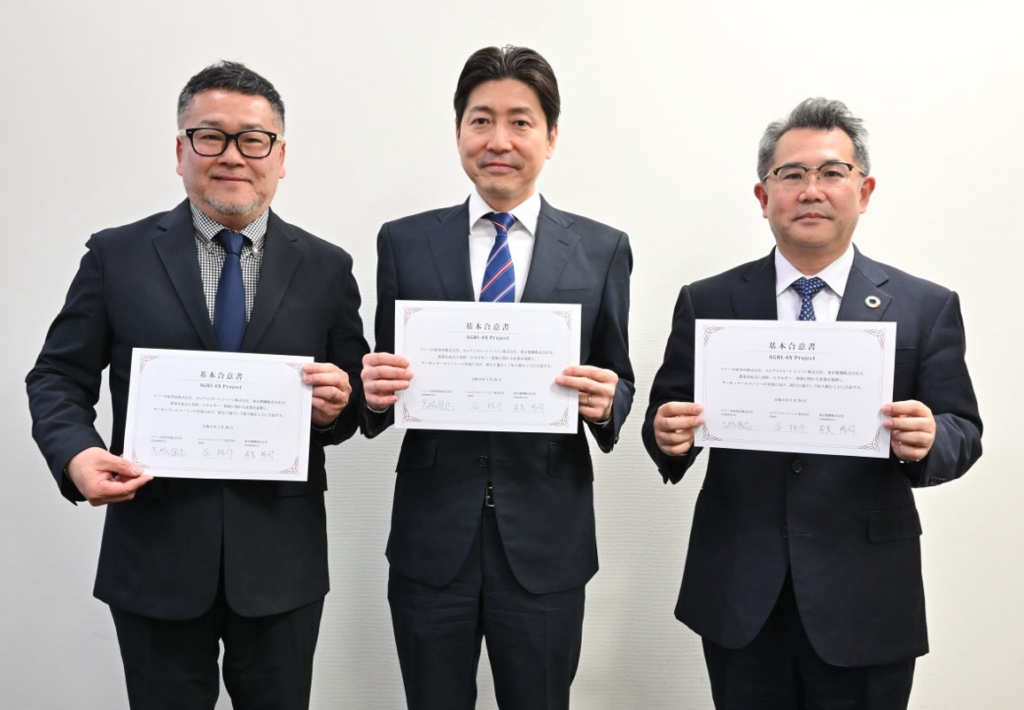
From left in the photo: President Takahashi of Farbo Research Institute, Director Tani of Electro Route Japan, President Nara of Tokyo Steel
Through a three-company collaboration with Farbo Research Institute and Tokyo Steel Manufacturing,
Simultaneously Building Climate Change Adaptive Agricultural Infrastructure and a Decarbonized Society
ElectroRoute Japan K.K. (Headquarters: Chiyoda-ku, Tokyo; President and CEO: Alan Mullane; hereinafter “ERJ”), an aggregator, has entered into a basic agreement with Farbo Research Corporation (Headquarters: Nichinan-cho, Tottori Prefecture; President and CEO: Ryuzo Takahashi; hereinafter “FRC”), which designs agricultural production and smart farming systems, and Tokyo Steel Manufacturing Co., Ltd. (Headquarters: Chiyoda-ku, Tokyo; President and CEO: Nobuaki Nara; hereinafter “Tokyo Steel”) to promote the social implementation project “AGRI-4X (tentative name)” aimed at establishing Japan’s food security and strengthening its energy and resource security.
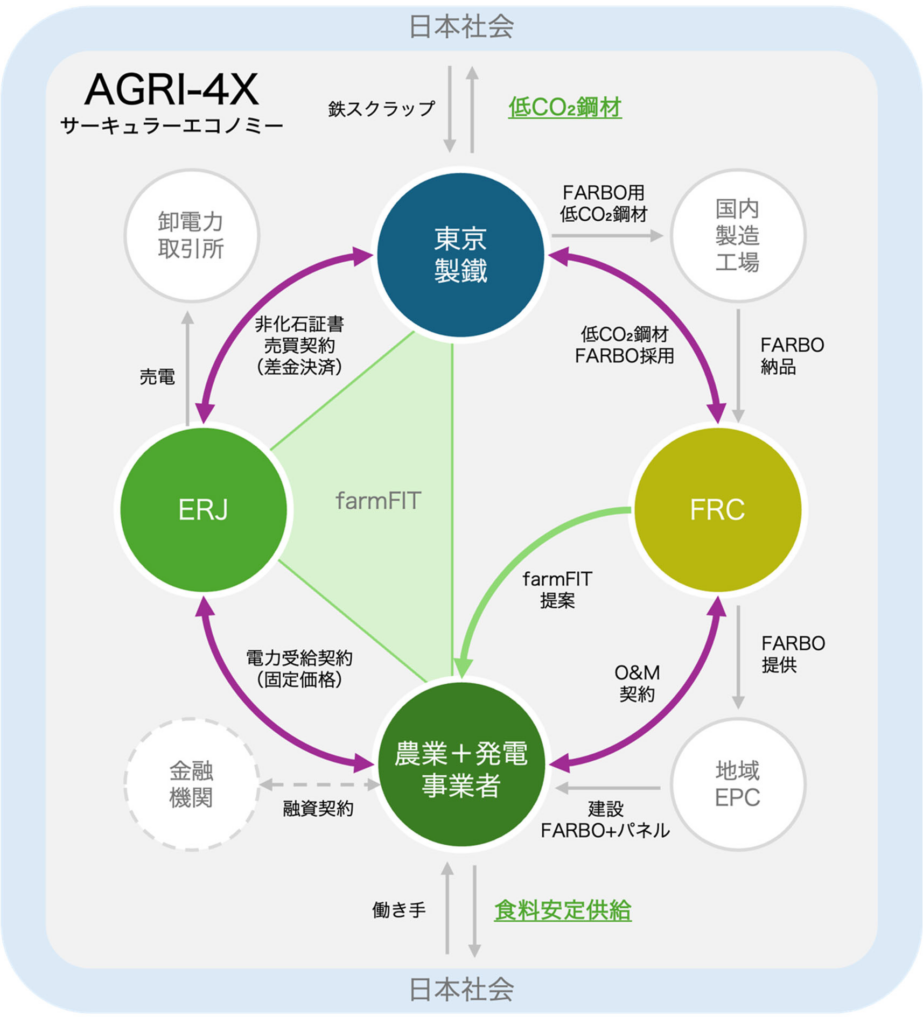
This project aims to build a circular economy connecting industries related to agriculture, food, energy, and resources. It begins with third parties (agricultural corporations, regional companies, new farmers, etc.) implementing a system combining solar panels with the smart agriculture equipment, the AgriTech system “FARBO-ATS (tentative name)” (FARBO-ATS, hereinafter “FARBO”), developed and provided by FRC, onto farmland.This enables third parties to achieve productivity gains and labor savings through high-tech agriculture. Simultaneously, they sell the generated electricity via the consumer-driven V-PPA scheme “farmFIT (tentative name)” (farmFIT). The revenue from this electricity sales is then used to recoup investments in the smart agriculture equipment, thereby establishing sustainable agricultural operations.ERJ supplies the environmental value derived from this electricity aggregated through “farmFIT” to Tokyo Steel. Tokyo Steel then utilizes the environmental value from this low-environmental-impact renewable energy, procured through this scheme and coexisting with the local community, to manufacture low-CO₂ steel “Nearly Zero.”Furthermore, by utilizing this low-CO₂ steel “Nearly Zero” as raw material for FARBO, FRC aims to realize a social infrastructure where value circulates from upstream to downstream and back to upstream.
■ Background and Purpose of the Concept
Against the backdrop of recent international developments, Japanese society faces compound risks stemming from its supply structure, which relies heavily on overseas sources for food, energy, and resources. Japan’s agriculture, central to food security, confronts structural challenges including increasing abandoned farmland due to the super-aging workforce and a shortage of successors.The Ministry of Agriculture, Forestry and Fisheries revealed at a Liberal Democratic Party subcommittee meeting on April 17, 2025, that 32.8% of all farmland nationwide lacks successors, placing the sustainability of agriculture as an industry in a precarious position.
Meanwhile, a December 2024 report by the Mitsubishi Research Institute (https://www.mri.co.jp/knowledge/column/20241204.html) estimates that agricultural solar power could account for over half of Japan’s solar power generation potential. Agricultural solar power is positioned as a powerful option capable of simultaneously achieving agricultural revitalization and decarbonization.
Given this context, Tokyo Steel has begun exploring the use of agrivoltaics not only for its own decarbonization but also from the perspective of Japan’s food security. Subsequently, FRC joined the effort, and the parties have engaged in repeated discussions on the potential for a new, agriculture-focused social implementation model.Furthermore, since Tokyo Steel operates its factories on a 24-hour basis, the transition to renewable energy necessitates the use of a V-PPA scheme that can ensure stable and continuous environmental value. This led to the participation of ERJ as the partner responsible for implementing this scheme.
This project aims to reconnect the previously fragmented domains of food, energy, and resources by placing agriculture at its origin and core, and by bringing together the strengths and needs of the three companies. It seeks to achieve a transformation (Trans ) of the industrial structure itself. Furthermore, we will promote this project as an open social implementation model designed to attract participation from other companies in the future.
Furthermore, by progressively expanding the adoption of “Nearly Zero” low-CO₂ steel—manufactured using scrap iron as raw material through this V-PPA scheme—in FARBO’s tower frames, we also aim to realize a circular economy that structurally incorporates resource circulation.
■ Overview of the “AGRI-4X” Project
AGRI-4X is a social model that integrates the design and implementation of Agriculture × Food × Energy × Resources
and aims to simultaneously achieve the following four transformations (4X):
・AGRI-X: Labor savings through smart agriculture and addressing the shortage of agricultural workers
・FOOD-X: Enhancing the sustainability and supply resilience of food production
・ENERGY-X: Expanding non-FIT/non-FIP renewable energy and achieving decarbonization
・RESOURCE-X: Promoting resource circulation and reducing import dependency
■ Features of the Technology and Scheme
1. Implementation of a “Movable Solar Radiation and Rainfall Adjustment System” Adapting to Climate Change
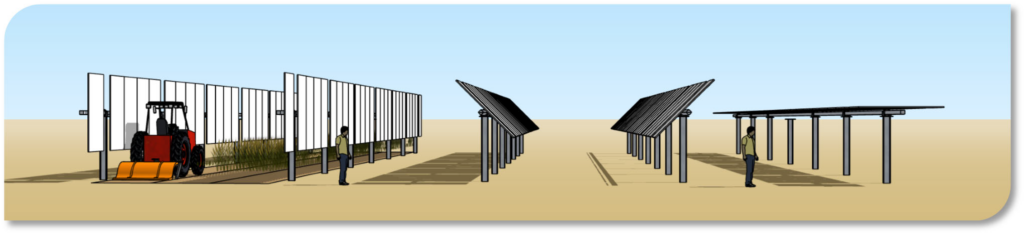
At the core of this project lies FARBO, designed and developed by FRC. FARBO primarily aims to physically regulate solar radiation and rainfall on farmland by controlling the opening and closing of a movable roof structure installed above the fields. This system targets open-field cultivation, which is constantly exposed to natural environmental conditions. It protects crops from increasingly severe abnormal weather events like extreme heat and torrential rains, while optimizing the growing environment for open-field cultivation. This contributes to improved crop quality and increased yields.
Figure 1. FARBO controlling the open-field cultivation environment
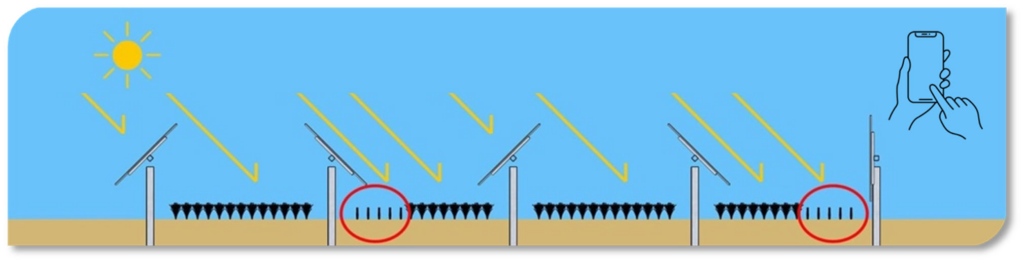
FARBO incorporates the environmental control program “V-mode” (international patent pending), which visualizes areas with uneven growth conditions via an application. It then focuses sunlight or adjusts rainfall to equalize crop growth. Additionally, daily data management using environmental composite sensors and soil sensors enables the implementation of highly reproducible smart agriculture, independent of experience or intuition. This makes environmental control previously difficult in open-field cultivation possible, contributing to improved crop quality and increased yields.
Figure 2. Environmental control program “V-mode” for uniform crop growth
2. Adding Solar Power Generation Capability and Energy Circulation
After strengthening the agricultural infrastructure through FARBO implementation, a third-party business operator can install solar panels on its movable structural components (hereinafter “FARBO+Solar”). This enables self-sufficient power generation for decarbonized agricultural operations while selling surplus electricity generated primarily during the off-season. Proceeds from this electricity sales can be applied toward the costs of introducing and operating smart agriculture, thereby stabilizing agricultural management.
*Note: Installing solar panels requires temporary conversion permission under the Agricultural Land Law.
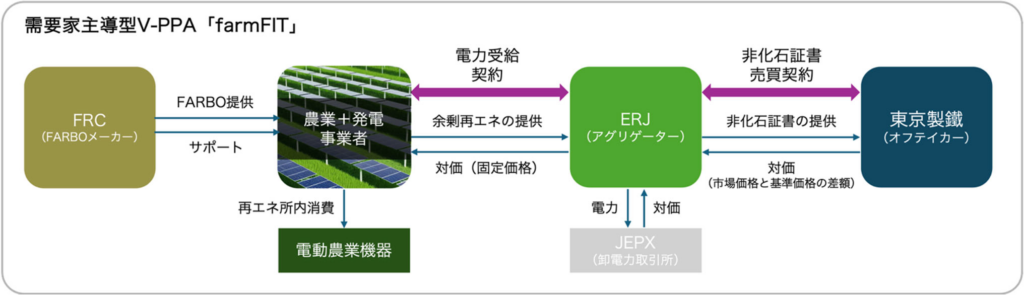
The environmental value derived from the generated electricity is aggregated through “farmFIT,” a consumer-led V-PPA scheme specifically for FARBO+ Solar, established through collaboration between FRC and ERJ, and supplied to Tokyo Steel.This secures an outlet for renewable energy supply, enabling power generators to sell electricity at a fixed price. By introducing additional, low-environmental-impact renewable energy that coexists with agriculture and local communities, it contributes to Tokyo Steel’s decarbonization efforts.
Figure 3. Consumer-led V-PPA scheme “farmFIT”
3. Building a Circular Economy with Low-CO₂ Steel
As the project progresses, the steel used for FARBO structural components will be gradually switched to low-carbon steel, achieved through measures such as utilizing recycled materials manufactured by Tokyo Steel. Ultimately, the low-carbon steel “Nearly Zero” produced using environmental value derived from FARBO+Solar will be adopted as raw material for FARBO. Furthermore, Tokyo Steel will utilize the environmental value derived from the electricity generated by the newly installed FARBO+Solar system. This will be applied to the production of low-CO₂ steel “Nearly Zero” and to reducing CO₂ emissions during manufacturing. This creates a virtuous cycle aimed at reducing environmental impact and building a circular economy.
Figure 4. AGRI-4X Circular Economy
■ Future Outlook
This project, based on FARBO+Solar, will commence with a 3MW-scale demonstration for Tokyo Steel in the initial phase through third-party implementation to verify technical and business viability. Subsequently, the scale will be expanded incrementally, aiming for a total deployment of 500MW to 2,000MW in the medium term.This will enable the reduction of Tokyo Steel’s Scope 2 emissions while also establishing a framework to implement CO₂ emission reductions across society through supply to other electricity consumers. Concurrently with this expansion process, the adoption rate of low-carbon steel materials (“nearly zero carbon”) in FARBO frame manufacturing will be progressively increased, with the long-term goal of achieving 100% adoption.This will advance the implementation of agricultural infrastructure structurally incorporating resource circulation and decarbonization. Furthermore, with a long-term vision of implementation across approximately 1% of Japan’s farmland (about 20,000 MW), we will promote nationwide deployment as a circular economy connecting agriculture, food, energy, and resources.
AGRI-4X redefines agriculture not merely as a primary industry, but as a foundational industry that serves as the starting point for food, energy, and resource security. We will contribute to the transition to a sustainable social structure by collaborating with relevant companies.
■ About the Companies
【ElectroRoute Japan K.K.】 https://electroroute.co.jp/
ElectroRoute Japan K.K. (the Japanese subsidiary of ElectroRoute Holdings, a wholly-owned subsidiary of Mitsubishi Corporation) is an energy provider specializing in aggregating various resources, primarily renewable energy.In recent years, it has focused on supporting corporate decarbonization management and Scope 2 reduction through providing environmental value via PPA schemes utilizing aggregated resources. In this project, it plays a role in the consumer-led V-PPA scheme “farmFIT,” minimizing balancing risks for fluctuating solar power through advanced forecasting technology and trading functions, thereby delivering environmental value to consumers.
【Farbo Research Institute Co., Ltd.】 https://farboresearchcenter.co.jp/
Farbo Research Institute Co., Ltd. (Agricultural Land Qualified Corporation | Formerly: Notus Research Institute) manages approximately 27 hectares of farmland in the mountainous regions of Tottori Prefecture, engaging in sustainable agriculture centered on pesticide-free and specially cultivated rice. Since its founding in 2009, it has received numerous awards at national rice competitions. It also operates Japan’s largest rice field ownership program, the “Rice Field Owners Club.”In recent years, we have also engaged in the research and development of specialized smart agriculture equipment for the increasingly super-aged field cultivation sector, promoting the social implementation of next-generation agricultural models.
【Tokyo Steel Manufacturing Co., Ltd.】 https://www.tokyosteel.co.jp/
Tokyo Steel Manufacturing Co., Ltd. is Japan’s largest electric furnace manufacturer, producing and selling steel products using electric furnaces. Through the supply of electric furnace steel products, primarily made from scrap iron, we actively advance initiatives toward resource-recycling manufacturing and the realization of a decarbonized society.In recent years, we have focused on establishing a manufacturing and supply system for “Nearly Zero” low-CO₂ steel, which significantly reduces CO₂ emissions in the manufacturing process through the use of renewable energy and the implementation of demand response (upward DR). This also contributes to reducing the environmental impact across the entire supply chain.
【Contact for Inquiries Regarding This Matter】
ElectroRoute Japan K.K. Commercial Department
commercial@electroroute.co.jp